For decades, families facing severe traumatic brain injury have lived with a painful assumption: once brain tissue is lost, recovery is limited to what the surviving brain can re-learn. Rehabilitation can help. Technology can assist. Time can produce surprises. But the central wound—the loss of brain cells, circuits, and connections—has often been treated as permanent. That assumption is beginning to change.
A recent preclinical study offers one of the clearest signals yet that brain regeneration is moving from aspiration toward experimental reality. Researchers transplanted human induced pluripotent stem cell-derived cortical grafts into mice after traumatic brain injury. The grafted cells survived, matured, extended projections, formed evidence of synaptic connections with the host brain, and were associated with improved motor function. In plain language: human-derived cortical cells placed into an injured brain showed evidence of becoming part of the brain’s circuitry and contributing to functional recovery.
This is not yet a therapy fully ready for clinical trials with people. It was performed in mice, not people. The injured human brain is larger, older, more complex, and more variable than any experimental model. Many hard questions remain: Can grafted tissue be made safely? Can it be produced reproducibly? Will new cells connect to the right targets? Can we prevent overgrowth, inflammation, rejection, or abnormal activity? Most importantly, can such an approach restore meaningful function in a person living with chronic brain injury?
Still, the observation is important because it touches the central challenge of brain regeneration. It is not enough to make neurons. It is not enough for transplanted cells to survive. A regenerative therapy must help rebuild circuits. It must connect new tissue to old tissue in ways that matter. The recent cortical graft study suggests that this may be biologically possible.
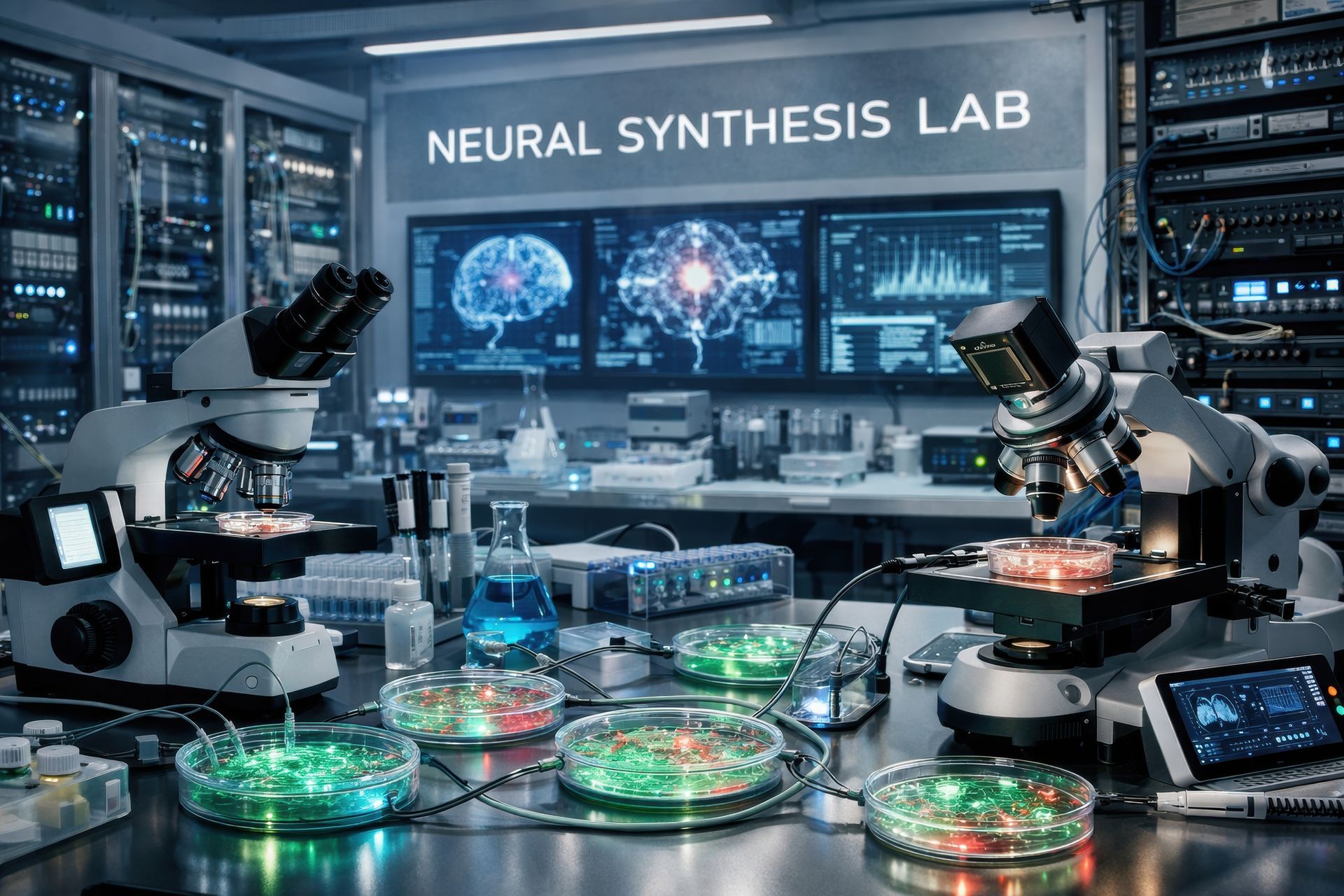
Equally important, the field is no longer relying only on isolated laboratories working at the edges of plausibility. In 2025, ARPA-H launched the Functional Repair of Neocortical Tissue program, known as FRONT, with the explicit goal of developing technologies to restore damaged neocortical tissue and help individuals recover cognitive and motor functions. The neocortex is the part of the brain responsible for many of the functions most affected by devastating injury: movement, sensation, perception, language, attention, planning, and decision-making. In May 2026, ARPA-H selected a multidisciplinary FRONT performer team led by Sophrosyne Biosciences to develop precursor tissue grafts designed to mimic normal brain development, generate structured neocortical tissue, and integrate with the adult brain. The program is planned across three technical phases over five years, with strict performance metrics.
That pathway also suggests how this science may move toward human trials. The next steps will likely include producing standardized, clinical-grade precursor tissue; proving reproducible graft survival and integration; demonstrating functional recovery in increasingly rigorous animal models; defining safety controls for growth, immune response, and abnormal activity; and engaging regulators through an FDA pre-IND process before any first-in-human study. ARPA-H’s award description specifically identifies validated precursor tissue, reproducible graft survival, and FDA pre-IND engagement as goals of the FRONT effort.
That combination—a concrete scientific result and a major federal commitment—is why this moment matters.
For the Dan Lewis Foundation, the significance is not that a cure is around the corner. It is that the scientific question has become sharper and more actionable. Can we replace lost cortical tissue? Can we guide new cells to become the right kinds of neurons? Can we help them organize into layered cortical structures? Can we persuade them to connect with the injured brain in a useful way? Can rehabilitation, stimulation, or brain-computer interfaces help train those new circuits after transplantation? These are no longer purely philosophical questions. They are experimental questions. And experimental questions can be tested, improved, funded, and translated.
Families affected by severe brain injury know better than anyone that hope must be honest. Progress in regenerative neuroscience will not be linear. Many approaches will fail. Some will prove unsafe. Others will work only in narrow settings. But the direction of the field is unmistakable: researchers are beginning to treat the injured brain not only as something to compensate for, but as something that may one day be repaired. That is the promise of brain regeneration research. Not instant recovery. Not miracle cures. But the disciplined pursuit of a future in which lost brain function is not automatically considered lost forever.
Reference: Gladen MD et al. Human induced pluripotent stem cell-derived cortical grafts restore motor function after traumatic brain injury. Neural Regeneration Research. 2026.